
In this guide
- 1. What is written down value (WDV) depreciation?
- 2. WDV vs straight-line: a worked example
- 3. Key terms
- 4. The three ways countries use WDV
- 5. WDV around the world at a glance
- 6. Country-by-country guide
- 7. Countries that mostly use straight-line instead
- 8. How WDV affects your assets
- 9. Book depreciation vs tax depreciation
- 10. Choosing and applying WDV: best practices
- 11. Common mistakes to avoid
- 12. How UniAsset handles WDV depreciation
- 13. Frequently asked questions
- 14. Check with your finance advisor
- 15. References
Key takeaways
- Written down value (WDV) depreciation charges a fixed percentage on the asset’s remaining value each year. Charges are highest early and shrink over time.
- The same idea goes by many names: reducing balance, declining balance, diminishing value, writing down allowance, capital cost allowance, degressive depreciation, amortissement dégressif, porcentaje constante.
- Countries use it in three ways: as the mandatory tax method on pooled assets (UK, Canada, India, Pakistan), as an optional method set as a multiple of straight-line (US, Japan, France, Spain, Australia, New Zealand, South Korea, China), or as a temporary investment incentive (Germany 2025–2027).
- Several rules changed recently: the UK main pool rate fell from 18% to 14% in April 2026, Germany allows up to 30% declining balance for assets bought July 2025 – December 2027, the US made 100% bonus depreciation permanent in 2025, Canada announced the return of its Accelerated Investment Incentive, and India’s Income-tax Act, 2025 took effect on 1 April 2026.
- WDV changes your net book value, your tax timing, and the gain or loss you report when you dispose of an asset. It does not change the total cost you eventually recover.
What is written down value (WDV) depreciation?
Every physical asset a business owns — a machine, a vehicle, a laptop, a generator — loses value as it is used. Depreciation spreads the asset’s cost across the years it helps earn revenue. The question is how you spread it.
Straight-line depreciation charges the same amount every year. Written down value depreciation charges the same percentage every year, applied to whatever value is left. Because the base keeps shrinking, so does the charge:
- Year 1: rate × original cost
- Year 2: rate × (cost − year 1 depreciation)
- Year 3: rate × (remaining value after year 2)
- …and so on.
The formula
Annual depreciation = Opening written down value × WDV rate
Closing written down value = Opening written down value − Annual depreciation
If you know the cost (C), the expected residual value (S) and the useful life in years (n), the rate that brings the asset down to its residual value is:
WDV rate = 1 − (S ÷ C)(1/n)
In practice, most tax systems don’t make you calculate this. They either publish the rate (the UK’s 14% main pool, Canada’s 20% for Class 8, India’s 15% for plant and machinery) or derive it from straight-line using a multiplier, such as “200% of the straight-line rate” in the US, Japan and Australia.
Why it exists
WDV reflects how many assets actually behave. A new delivery van or server loses more of its value and usefulness in its first two years than in its seventh. Front-loading depreciation also gives businesses earlier tax deductions, which is why governments use it, and adjust it, as an investment incentive.
One idea, many names
| Name | Where you’ll hear it |
|---|---|
| Written down value (WDV) | India, Pakistan, Bangladesh, Sri Lanka, many Commonwealth countries |
| Reducing balance | UK, Ireland, Pakistan, general IFRS usage |
| Writing down allowance (WDA) | United Kingdom (capital allowances) |
| Declining balance / double-declining balance | United States, Canada, Japan, South Korea, China |
| Capital cost allowance (CCA) | Canada |
| Diminishing value (DV) | Australia, New Zealand |
| Diminishing balance | IFRS (IAS 16) |
| Degressive depreciation (degressive AfA) | Germany |
| Amortissement dégressif | France |
| Amortización según porcentaje constante | Spain |
WDV vs straight-line: a worked example
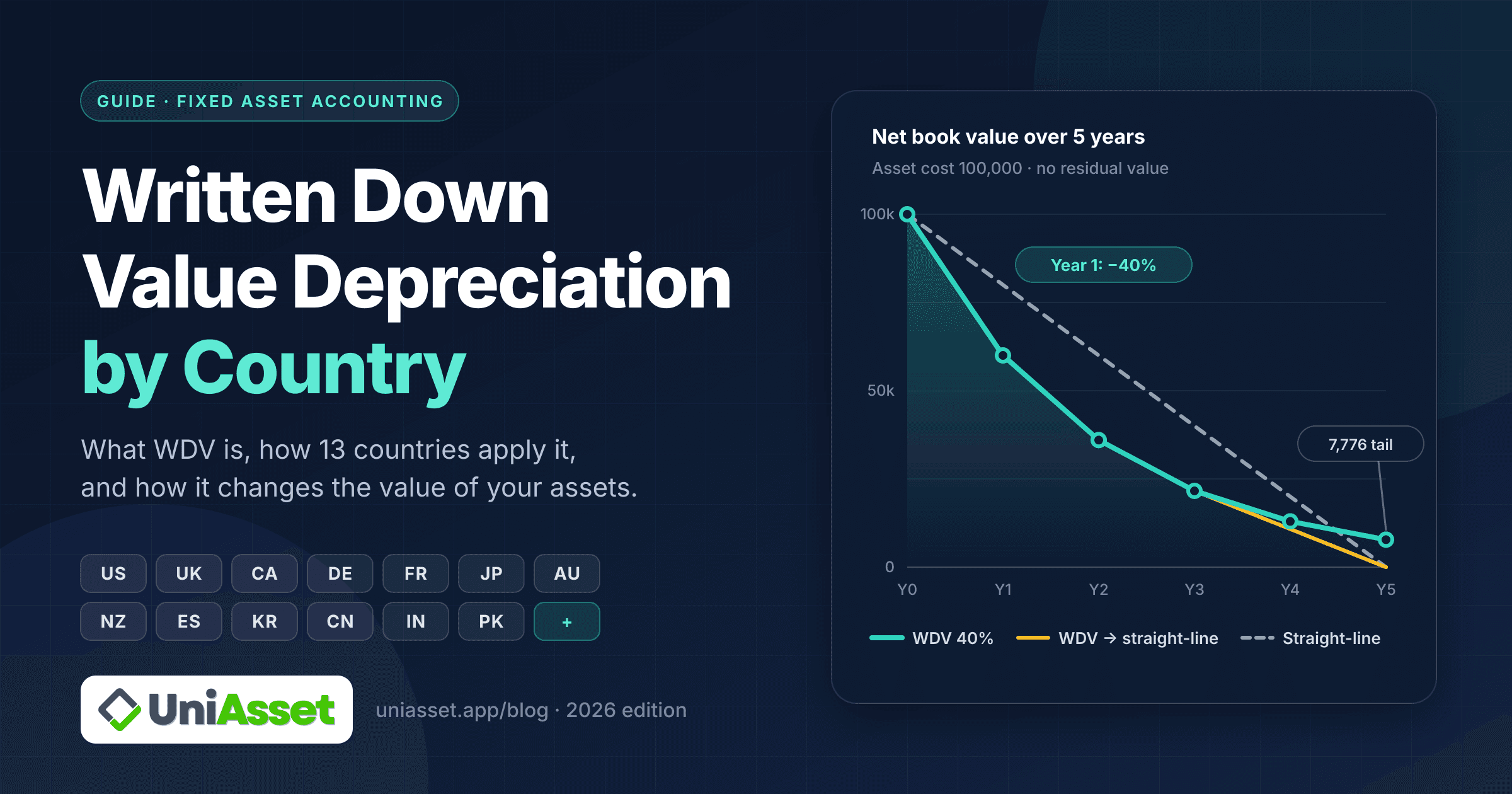
Take an asset that costs 100,000 (any currency) with a five-year useful life and no residual value.
- Straight-line: 100% ÷ 5 = 20% of cost per year.
- WDV at 200% of straight-line (“double-declining”): 2 × 20% = 40% of the remaining value per year.
- WDV with a switch to straight-line: used in the US, Japan and France. You switch once straight-line on the remaining value gives a bigger charge than the declining-balance rate.
| Year | Straight-line charge | Straight-line NBV | WDV 40% charge | WDV 40% NBV | WDV → SL switch charge | WDV → SL switch NBV |
|---|---|---|---|---|---|---|
| 1 | 20,000 | 80,000 | 40,000 | 60,000 | 40,000 | 60,000 |
| 2 | 20,000 | 60,000 | 24,000 | 36,000 | 24,000 | 36,000 |
| 3 | 20,000 | 40,000 | 14,400 | 21,600 | 14,400 | 21,600 |
| 4 | 20,000 | 20,000 | 8,640 | 12,960 | 10,800 | 10,800 |
| 5 | 20,000 | 0 | 5,184 | 7,776 | 10,800 | 0 |
| Total | 100,000 | 92,224 | 100,000 |
- Straight-line
- WDV 40%
- WDV 40% → switch to SL
Key terms
- Net book value (NBV) / carrying amount
- cost minus accumulated depreciation, as shown in the financial statements.
- Tax written down value / tax written-down value / UCC
- the remaining value for tax purposes. It is often different from NBV. Canada calls it undepreciated capital cost (UCC); New Zealand calls it adjusted tax value.
- Pool / block / class
- a group of assets depreciated together at one rate (UK pools, Canadian CCA classes, Indian blocks of assets). Individual assets lose their separate tax value once they enter a pool.
- Multiplier (e.g., 200%, 150%, 2.25×)
- how many times the straight-line rate the declining-balance rate is.
- Switch-over
- the point where a method changes from declining balance to straight-line.
- First-year convention
- a rule that changes the first year’s charge, such as the half-year rule, the mid-quarter convention, or a reduced rate for assets used only part of the year.
- First-year allowance / bonus depreciation / immediate expensing
- an extra deduction in the year of purchase, on top of or instead of normal WDV.
- Balancing charge / recapture
- tax that becomes payable when you sell an asset for more than its tax written down value.
- Balancing allowance / terminal loss
- a deduction when you sell for less than the tax written down value and the pool or class closes.
- Residual (salvage) value
- the amount you expect to recover at the end of the asset’s life.
The three ways countries use WDV
Nearly every country allows reducing-balance depreciation somewhere in its rules. IFRS (IAS 16) lists the diminishing balance method as an acceptable method for financial statements, and so do US GAAP and most local accounting standards. So asking how many countries use WDV has no single answer.
Where countries really differ is tax depreciation. They fall into three broad models:
1. Mandatory WDV on pooled assets. The tax law sets a rate per class of asset and applies it to the pool’s remaining balance every year. You rarely choose the method.
Examples: United Kingdom, Canada, India, Pakistan.
2. Optional declining balance, set as a multiple of straight-line. You choose straight-line or declining balance, asset by asset. The declining-balance rate is a fixed multiple of the straight-line rate, often with a switch to straight-line later in life.
Examples: United States, Japan, France, Spain, Australia, New Zealand, South Korea, China.
3. Temporary WDV as an investment incentive. Straight-line is the normal rule, but the government opens a time-limited window where declining balance is allowed to encourage investment.
Example: Germany (most recently July 2025 – December 2027).
WDV around the world at a glance
Countries are listed alphabetically. Rules are summarised as of November 2026; always confirm the current position (see Check with your finance advisor).
| Country | Model | Typical WDV rule | Applies to | Recent change |
|---|---|---|---|---|
| Australia | Optional | Diminishing value = base value × days held/365 × 200% ÷ effective life | Most depreciating assets (Division 40) | 200% factor for assets held from 10 May 2006 (150% before) |
| Canada | Mandatory, pooled | Capital cost allowance per class on the declining balance (e.g., Class 8 at 20%, Class 10 at 30%, Class 50 at 55%) | Almost all depreciable property | Budget 2025 announced reinstatement of the Accelerated Investment Incentive |
| China | Optional / incentive | Double-declining balance or sum-of-years-digits for qualifying assets; straight-line otherwise | Qualifying assets and sectors | Accelerated methods widened since 2014 |
| France | Optional | Amortissement dégressif: straight-line rate × 1.25 / 1.75 / 2.25 | New qualifying equipment | Long-standing (CGI Art. 39 A) |
| Germany | Temporary incentive | Degressive AfA up to 3× straight-line, max 30% a year | Movable assets acquired 1 Jul 2025 – 31 Dec 2027 | Investment booster, passed July 2025 |
| India | Mandatory, pooled | WDV on blocks of assets at prescribed rates (e.g., 15% plant & machinery, 40% computers, 10% buildings) | All tax depreciation | Income-tax Act, 2025 in force from 1 Apr 2026 |
| Japan | Default for most equipment | 200% declining balance with a guaranteed-amount switch to a revised rate | Machinery, equipment, vehicles | 200% for assets acquired from 1 Apr 2012 (250% before) |
| New Zealand | Optional | Diminishing value or straight-line at IRD-published economic rates | Most depreciable property | Plant rates based on double-declining balance since 2005 |
| Pakistan | Mandatory | Reducing balance at Third Schedule rates, plus 25% initial allowance on plant & machinery | All tax depreciation | Long-standing (Income Tax Ordinance 2001) |
| South Korea | Optional | Straight-line or declining balance (5% salvage value required) | Tangible assets other than buildings | Long-standing |
| Spain | Optional | Porcentaje constante: straight-line coefficient × 1.5 / 2 / 2.5 | Most assets except buildings, furniture and fittings | Long-standing (Law 27/2014) |
| United Kingdom | Mandatory, pooled | Writing down allowance on pools: main pool 14%, special rate pool 6% | Plant & machinery | Main pool cut from 18% to 14% from April 2026; new 40% first-year allowance |
| United States | Built into MACRS | 200% or 150% declining balance, switching to straight-line | Personal property (3- to 20-year classes) | 100% bonus depreciation made permanent (property acquired after 19 Jan 2025) |
Country-by-country guide
Australia — diminishing value (Division 40)
The rule. Under the uniform capital allowance system in Division 40 of the Income Tax Assessment Act 1997, businesses choose between prime cost (straight-line) and diminishing value for each depreciating asset.
How it’s calculated. For assets first held on or after 10 May 2006, diminishing value is:
Base value × (days held ÷ 365) × (200% ÷ asset’s effective life)
Assets held before that date use 150% instead of 200%. The effective life comes from the Commissioner’s published determinations, or you can estimate it yourself.
Example. An asset costing A$80,000 with a 5-year effective life: year 1 = 80,000 × 40% = A$32,000. Year 2 = 48,000 × 40% = A$19,200.
What to watch. The days-held proration means part-year assets get a part-year deduction. Once you pick a method for an asset, you generally stay with it. Small-business concessions and instant asset write-off thresholds change often, so check them each year.
Canada — capital cost allowance (CCA)
The rule. Canada’s tax depreciation is the capital cost allowance under the Income Tax Act and Schedule II of the Income Tax Regulations. Assets go into classes, each with a prescribed rate applied to the class’s undepreciated capital cost (UCC), a declining balance.
Common classes. Class 1 buildings (4%), Class 8 furniture and most equipment (20%), Class 10 vehicles (30%), Class 50 computer hardware (55%).
First-year rules.
- Half-year rule: normally only half the net additions to a class are counted in the year of purchase. A Class 8 asset gets 10% in year 1 instead of 20%.
- Accelerated Investment Incentive (AII): introduced in the 2018 Fall Economic Statement for property acquired after 20 November 2018. It suspended the half-year rule and allowed 1.5× the normal first-year CCA, so the Class 8 example gets 30% in year 1. It was being phased out from 2024. Budget 2025 (4 November 2025) announced its reinstatement as part of a “Productivity Super-Deduction”, alongside immediate expensing for manufacturing and processing equipment.
What to watch. Because everything sits in a pool, selling an asset reduces the class’s UCC rather than creating a gain or loss straight away. Recapture or a terminal loss comes up only when the pool balance goes negative or the class is emptied. Confirm whether the Budget 2025 measures have been enacted, and their exact start dates, before relying on them.
China — accelerated methods for qualifying assets
The rule. Under the Enterprise Income Tax Law, the default tax method is straight-line over minimum useful lives (for example, 20 years for buildings). Since 2014, a series of policies has let qualifying enterprises and assets use accelerated depreciation: either a shorter life (down to 60% of the minimum period) or the double-declining balance or sum-of-years-digits method.
Who qualifies. The policies started with specific manufacturing and technology sectors and were later widened to all manufacturing. Separate rules allow a one-off deduction for qualifying lower-value equipment.
What to watch. Once a method is adopted for an asset, it generally can’t be changed. The one-off deduction thresholds and expiry dates have been extended several times, so check the current notice.
France — amortissement dégressif
The rule. Article 39 A of the Code général des impôts allows declining-balance depreciation for qualifying new industrial equipment with a useful life of at least three years. The rate is the straight-line rate multiplied by a fixed coefficient:
| Normal useful life | Coefficient | Example rate |
|---|---|---|
| 3 or 4 years | 1.25 | 4 years: 25% × 1.25 = 31.25% |
| 5 or 6 years | 1.75 | 5 years: 20% × 1.75 = 35% |
| More than 6 years | 2.25 | 10 years: 10% × 2.25 = 22.5% |
How it’s calculated. Depreciation runs from the first day of the month of acquisition, and the rate is applied each year to the remaining value. When straight-line over the remaining years gives a higher charge, you switch to straight-line.
What to watch. Second-hand assets, passenger vehicles and most buildings are excluded. When the tax charge exceeds the accounting charge, French companies record the difference as amortissement dérogatoire (excess tax depreciation).
Germany — degressive AfA (temporary)
The rule. Germany’s default is straight-line depreciation (lineare AfA) under §7 of the Einkommensteuergesetz. Declining balance (degressive AfA) has been switched on in limited windows to boost investment:
| Acquisition window | Max multiple of straight-line | Max annual rate |
|---|---|---|
| 2020 – 2022 | 2.5× | 25% |
| April – December 2024 | 2× | 20% |
| 1 July 2025 – 31 December 2027 | 3× | 30% |
The current window comes from the investment booster (Investitions-Booster) in the tax investment programme passed in July 2025. It applies to movable fixed assets (machinery, equipment, vehicles) acquired or produced in the window. Buildings and intangible assets are excluded.
Example. A machine with a 10-year life (10% straight-line) can be depreciated at 30% of its remaining value. A machine with a 5-year life (20%) is capped at 30%, not 60%.
What to watch. Purely electric vehicles bought in the same window get a separate, steeper schedule starting at 75% in the first year. Assets bought outside a window stay on straight-line for their whole life.
India — WDV on blocks of assets
The rule. For tax, India uses the written down value method on blocks of assets: groups of assets of the same type with the same prescribed rate. Straight-line isn’t available for tax (except for certain power undertakings). From 1 April 2026, the Income-tax Act, 2025 replaced the Income-tax Act, 1961. The depreciation deduction now sits in section 33 and the definition of written down value in section 41. The block concept and WDV method continue, and closing WDV on 31 March 2026 carries forward without adjustment.
Typical rates. 15% for most plant and machinery, 40% for computers and software, 10% for most buildings, 10% for furniture.
First-year rule. If an asset is put to use for less than 180 days in the year of purchase, only half the normal rate is allowed that year.
Books vs tax. For financial statements, companies follow Schedule II of the Companies Act, 2013, which lets them use straight-line or WDV based on useful life. Most companies therefore keep two depreciation figures.
Japan — 200% declining balance with a guaranteed amount
The rule. Under Japan’s corporate tax rules, most machinery, equipment, tools and vehicles can be depreciated with the declining-balance method. For assets acquired on or after 1 April 2012 the rate is 200% of the straight-line rate. Assets acquired between 1 April 2007 and 31 March 2012 used 250%. Buildings must use straight-line, as must building fixtures and structures acquired from 1 April 2016.
The guaranteed amount. Each useful life has a guarantee rate. When the normal declining-balance charge falls below acquisition cost × guarantee rate, you switch to a revised rate applied to the remaining value from then on. This makes the remaining years straight-line and ensures the asset is fully written off, down to a ¥1 memorandum value.
What to watch. Corporations generally get declining balance as the default for eligible assets. Individuals default to straight-line and must apply to use declining balance.
New Zealand — diminishing value or straight-line
The rule. Under the Income Tax Act 2007, Inland Revenue (IRD) publishes an economic depreciation rate for each asset type, in both diminishing value (DV) and straight-line (SL) versions. Businesses choose per asset.
How the rates are set. Since 2005, the economic rates for most plant and equipment have been calculated using the double-declining balance method, with an equivalent straight-line rate published alongside. For example, a passenger vehicle is typically 30% DV or 21% SL.
What to watch. You can change methods at the end of an income year, and you don’t have to use the same method for every asset. Low-value assets under the current threshold (NZ$1,000) can be written off immediately. Most buildings currently have a 0% depreciation rate for tax.
Pakistan — reducing balance with initial allowance
The rule. Under section 22 of the Income Tax Ordinance, 2001, normal depreciation is calculated by applying the rates in Part I of the Third Schedule to the asset’s written down value at the beginning of the tax year. Typical rates are 10% for buildings and 15% for furniture and plant.
Initial allowance. Section 23 allows an initial allowance of 25% of cost for eligible plant and machinery put into service in Pakistan for the first time. It is deducted before normal depreciation starts.
What to watch. No normal depreciation is allowed in the year an asset is disposed of. The difference between sale proceeds and written down value is then taxed or deducted as business income. Total deductions over an asset’s life can’t exceed its cost.
South Korea — straight-line or declining balance
The rule. Korea’s Corporate Tax Act allows straight-line or declining balance for tangible fixed assets other than buildings and plant. Buildings and intangible assets must use straight-line.
How it’s calculated. Declining-balance rates assume a 5% salvage value. Straight-line assumes zero. Useful lives come from statutory tables, and companies can choose within a permitted range.
What to watch. The chosen method must be reported to the tax office and applied consistently.
Spain — porcentaje constante (constant percentage)
The rule. Article 12.1(b) of Spain’s Corporate Income Tax Law (Ley 27/2014) accepts depreciation at a constant percentage on the remaining value. The percentage is the straight-line coefficient from the official tables multiplied by:
| Depreciation period | Multiplier |
|---|---|
| Less than 5 years | 1.5 |
| 5 to less than 8 years | 2 |
| 8 years or more | 2.5 |
The constant percentage can’t be lower than 11%.
Example. A 5-year asset (20% straight-line) can be depreciated at 20% × 2 = 40% of its remaining value.
What to watch. Buildings, furniture and fittings can’t use this method. Sum-of-years-digits is a separate permitted method under the same article.
United Kingdom — writing down allowances on pools
The rule. UK businesses don’t deduct accounting depreciation for tax. They claim capital allowances under the Capital Allowances Act 2001. Plant and machinery not fully relieved by first-year reliefs goes into pools, and each year a writing down allowance (WDA) is claimed on the pool’s reducing balance:
| Pool | Rate |
|---|---|
| Main pool | 14% from April 2026 (18% before) |
| Special rate pool (e.g., integral features, long-life assets, some cars) | 6% |
| Single asset pools | Depends on the item |
When it changed. The Autumn Budget on 26 November 2025 announced the main rate cut. It took effect on 1 April 2026 for Corporation Tax and 6 April 2026 for Income Tax. Accounting periods that straddle the change use a time-apportioned hybrid rate.
Reliefs that sit on top. The Annual Investment Allowance (100% up to £1 million a year), full expensing for companies on new main-rate assets, and a new 40% first-year allowance available from 1 January 2026, which also covers some businesses excluded from full expensing.
What to watch. Selling an asset reduces the pool. A balancing charge comes up only if proceeds exceed the pool balance, and a balancing allowance usually only when the business stops trading.
United States — MACRS declining balance
The rule. US tax depreciation follows the Modified Accelerated Cost Recovery System (MACRS) under Internal Revenue Code §168. Under the General Depreciation System:
- 3-, 5-, 7- and 10-year property (computers, vehicles, office furniture, most machinery) uses 200% declining balance.
- 15- and 20-year property (land improvements, certain utility property) uses 150% declining balance.
- Both switch to straight-line in the year that gives a larger deduction.
- Residential rental property (27.5 years) and nonresidential real property (39 years) use straight-line.
Conventions. The half-year convention treats assets as placed in service mid-year. The mid-quarter convention applies instead if more than 40% of the year’s additions are placed in service in the last quarter.
When it changed. The One Big Beautiful Bill Act, signed 4 July 2025, permanently restored 100% bonus depreciation for qualifying property acquired after 19 January 2025. Property acquired earlier stays on the old phase-down (40% for 2025). The Act also raised the §179 expensing limit to $2.5 million, phasing out above $4 million of purchases.
What to watch. Many businesses expense most equipment in year one using bonus depreciation or §179, so MACRS declining balance matters most for assets that are excluded, elected out, or depreciated for state tax in states that don’t follow federal bonus depreciation. Book depreciation under US GAAP is separate.
Countries that mostly use straight-line instead
Not every system uses WDV for tax. A few examples for contrast:
- Ireland: plant and machinery wear-and-tear allowances are generally 12.5% straight-line over eight years.
- Singapore: capital allowances are generally claimed straight-line over the asset’s prescribed working life. Accelerated options are available over three years, or one year for low-value assets.
- Italy: tax depreciation generally follows straight-line ministerial coefficients by industry and asset type.
Even in these countries, companies reporting under IFRS can still use the diminishing balance method in their financial statements if it best reflects how the asset is used. The tax and book figures simply differ.
How WDV affects your assets
WDV doesn’t change what an asset cost or what it’s physically worth. It changes when that cost is recognised. That timing still affects several things.
1. Your net book value drops faster
In the worked example, after two years the asset shows 36,000 under WDV versus 60,000 under straight-line. Your balance sheet looks lighter, so ratios such as return on assets and asset turnover look stronger, while total assets look smaller.
2. Your tax arrives later, not lower
Bigger deductions early mean lower taxable profit in the first years and higher taxable profit later. The total deduction over the asset’s life is the same. The benefit is cash flow and the time value of money. That’s why governments raise or lower WDV rates to encourage or slow investment.
3. Book and tax values drift apart
If your accounts use straight-line but your tax return uses WDV (or the reverse), the two values diverge. Under IFRS and US GAAP, that gap creates deferred tax that needs tracking and reconciling every year.
4. Disposals produce bigger gains
Because WDV pushes book value down quickly, selling an asset a few years in often produces a gain against NBV. In pooled tax systems, the sale instead reduces the pool and can trigger a balancing charge or recapture later. Either way, you need an accurate WDV at the date of disposal.
5. The “never quite zero” tail
Pure WDV leaves a residual balance. Fully used assets can sit on the register at small values for years unless your method switches to straight-line, sets a residual floor, or the asset is formally disposed of or written off.
6. Replacement decisions look different
A machine that’s “almost fully depreciated” under WDV may still have years of useful life, and one with a high NBV under straight-line may be worn out. Depreciation is an accounting allocation, not a condition report. Pair it with maintenance cost history, condition and downtime before deciding to replace.
7. Multinationals juggle several regimes
A group with sites in the UK, Germany and the US could have the same model of forklift on three different tax schedules: a 14% pool, 30% degressive AfA, and 200% DB MACRS (or 100% bonus). Group reporting usually needs one consistent book method, with local tax schedules maintained separately.
Book depreciation vs tax depreciation
| Aspect | Book (accounting) depreciation | Tax depreciation |
|---|---|---|
| Purpose | Show the asset’s consumption fairly in the financial statements | Calculate taxable profit under the law |
| Rules | IFRS (IAS 16), US GAAP (ASC 360), local GAAP | National tax law (rates, pools, conventions) |
| Method choice | Whichever best reflects the pattern of consumption: straight-line, diminishing balance or units of production | Prescribed or limited by law |
| Level | Usually individual asset or component | Individual asset (US, Japan, France) or pool/block (UK, Canada, India) |
| Changes | Reviewed at least annually; changes are a change in estimate | Rates change with budgets and legislation |
| Output | Net book value, Fixed Asset Register | Tax computation, capital allowance or CCA schedules |
Choosing and applying WDV: best practices
Policy
- Set depreciation per asset category, not per asset, so similar assets are treated the same way.
- Use WDV for categories that lose value or usefulness fastest when new: IT hardware, vehicles, mobile equipment, technology-heavy machinery.
- Use straight-line for long-lived assets with steady use: buildings, fit-outs, infrastructure, furniture.
- Write down the reason for each method choice. Auditors will ask.
Data
- Record purchase date, in-service date, cost and residual value accurately. WDV is sensitive to the starting point.
- Capture disposal dates and proceeds the day they happen, so gains, losses and pool adjustments are correct.
- Keep maintenance and repair cost against each asset. It’s how you tell whether a low-WDV asset is a bargain or a money pit.
Process
- Recalculate at each financial year-end using your organisation’s own year start, not the calendar year.
- Produce a Fixed Asset Register snapshot at each year-end: cost, accumulated depreciation and NBV per asset.
- Review tax rates every year. In 2025–26 alone, the UK, Germany, the US, Canada and India all changed their rules.
Common mistakes to avoid
| Mistake | What goes wrong | Better approach |
|---|---|---|
| Applying the WDV rate to original cost every year | That’s straight-line at a higher rate; the asset is written off far too fast | Apply the rate to the opening written down value |
| Using the tax rate as the book rate by default | Financial statements don’t reflect actual use; auditors challenge it | Set book rates from useful life; keep tax rates separate |
| Ignoring first-year rules (half-year, 180-day, mid-quarter, days held) | Year-one depreciation is overstated or understated | Apply the convention your rules require from the in-service date |
| Forgetting the tail | Fully used assets linger at small values for years | Use a switch-over, a residual floor, or formal disposal |
| Not recording disposals | Ghost assets keep depreciating; pool and NBV figures drift | Record disposal date, method and proceeds promptly |
| Assuming last year’s rate still applies | Wrong claims after budget changes (e.g., UK 18% → 14%) | Confirm rates with your advisor each year |
| Mixing currencies in one register without care | Totals become meaningless | Keep each entity’s register in its own reporting currency |
How UniAsset handles WDV depreciation
UniAsset is an asset management platform, not a tax engine. It helps you keep the asset-level book depreciation and records that your accountants and auditors rely on.
- Six depreciation methods: straight line, declining balance, double declining, written-down value, MACRS and sum-of-years-digits.
- Configured per category: set useful life, rate and residual value percentage once for a category such as “Laptops” or “Forklifts”, and every asset in it follows.
- Salvage floor: set an optional salvage value per asset so book value never drops below what you expect to recover. This handles WDV’s long tail.
- Net book value per asset, rolled up across your whole portfolio.
- Fixed Asset Register: a point-in-time statement of gross cost, accumulated depreciation and NBV per asset, with filters and export for year-end and audit.
- Disposal with gain or loss: record the date, method and proceeds, and UniAsset calculates the gain or loss against net book value.
- Total cost of ownership and cost risk: see which assets have cost far more in maintenance than they’re worth, whatever their WDV says.
- Your currency and financial year: each organisation has its own currency and financial year start month.
Depreciation and financial reports are available on the Orbit plan and above; formal disposal accounting on Odyssey and above. Pooled tax computations (UK capital allowance pools, Canadian CCA classes, Indian blocks of assets) belong in your tax software. Export your Fixed Asset Register as the clean starting point.
Track WDV and net book value for every asset — free to start
Frequently asked questions
What is the WDV method of depreciation?
The written down value method charges depreciation as a fixed percentage of an asset's remaining value each year. Because the remaining value shrinks, each year's charge is smaller than the last. It is also called reducing balance, declining balance or diminishing value.
How do you calculate written down value?
Multiply the opening written down value by the WDV rate to get the year's depreciation, then subtract it to get the closing written down value. For example, an asset of 100,000 at 40% is depreciated by 40,000 in year one, leaving 60,000. Year two's charge is 40% of 60,000, which is 24,000.
What is the difference between WDV and straight-line depreciation?
Straight-line charges the same amount every year based on original cost. WDV charges the same percentage every year based on the remaining value, so it front-loads depreciation. Both recover the same total cost over the asset's life, but WDV recovers more of it early.
Which countries use the WDV method?
Most countries allow it for financial reporting under IFRS or local GAAP. For tax, it's mandatory on pooled assets in the United Kingdom, Canada, India and Pakistan. It's optional or built into the system in the United States (MACRS), Japan, France, Spain, Australia, New Zealand, South Korea and China. Germany allows it temporarily for movable assets acquired between July 2025 and December 2027.
Is double-declining balance the same as WDV?
Double-declining balance is a type of WDV where the rate is twice the straight-line rate: 40% for a five-year asset. WDV is the broader term for any fixed rate applied to the remaining balance.
Does WDV depreciation ever reach zero?
Pure WDV never mathematically reaches zero. Tax systems handle this by switching to straight-line later in the asset's life (US, Japan, France), by keeping assets in a pool that continues to shrink (UK, Canada, India), or by allowing a write-off when the asset is disposed of.
Is WDV better than straight-line?
Neither is better in general. WDV suits assets that lose value or usefulness quickly when new and gives earlier tax deductions where tax law allows it. Straight-line suits assets used steadily over a long life. Choose for each asset category, and follow your country's tax rules.
Can I use WDV in my accounts and straight-line for tax (or the reverse)?
In most countries, yes. Book and tax depreciation follow different rules, and the difference is tracked as deferred tax. Some countries link book and tax treatment more closely, so confirm with your advisor.
What changed in WDV rules in 2025–2026?
The UK cut the main pool writing down allowance from 18% to 14% from April 2026 and added a 40% first-year allowance. Germany introduced up to 30% declining balance for movable assets bought from July 2025 to December 2027. The US made 100% bonus depreciation permanent for property acquired after 19 January 2025. Canada's Budget 2025 announced the reinstatement of its Accelerated Investment Incentive. India's Income-tax Act, 2025 replaced the 1961 Act from 1 April 2026 while keeping WDV on blocks of assets.
Can asset management software calculate WDV automatically?
Yes. Asset management platforms such as UniAsset calculate WDV and other depreciation methods per asset from the category settings, track net book value over time, and produce a Fixed Asset Register for year-end. Country-specific tax pool computations are usually done in tax software or by your advisor.
Check with your finance advisor
References
Official and primary sources used for this guide:
- International (IFRS)
- Canada
- Germany
- United Kingdom
Bring every asset’s depreciation into one register
Choose a method for each category, track net book value across all your sites, and export a Fixed Asset Register at year-end.